
Why Buy Handmade Pottery? Why the Things We Use Every Day Matter

We probably don't give much thought to most of the objects we use every day. A mug is a mug, until you find the one you always reach for first.
I think that's part of what draws me to making functional pottery. These are objects that become woven into daily life. The mug you make coffee in every morning, the bowl that's always used for breakfast, or the vase you instinctively reach for when you bring flowers home.
Handmade pottery doesn't need to be saved for special occasions. For me, its value is almost the opposite. It's in using something made with care so often that it gradually becomes familiar.
So what actually makes handmade pottery different?
The marks of making are part of the piece
One of the things I love about handmade ceramics is that no two pieces will ever be completely identical.
I make my pottery in small batches, predominantly on the wheel, and even when I'm making a row of mugs from the same collection, there will always be subtle differences between them. The curve of a rim, the pull of a handle, a carved line or the way a glaze moves during firing will make each one slightly different from the next.
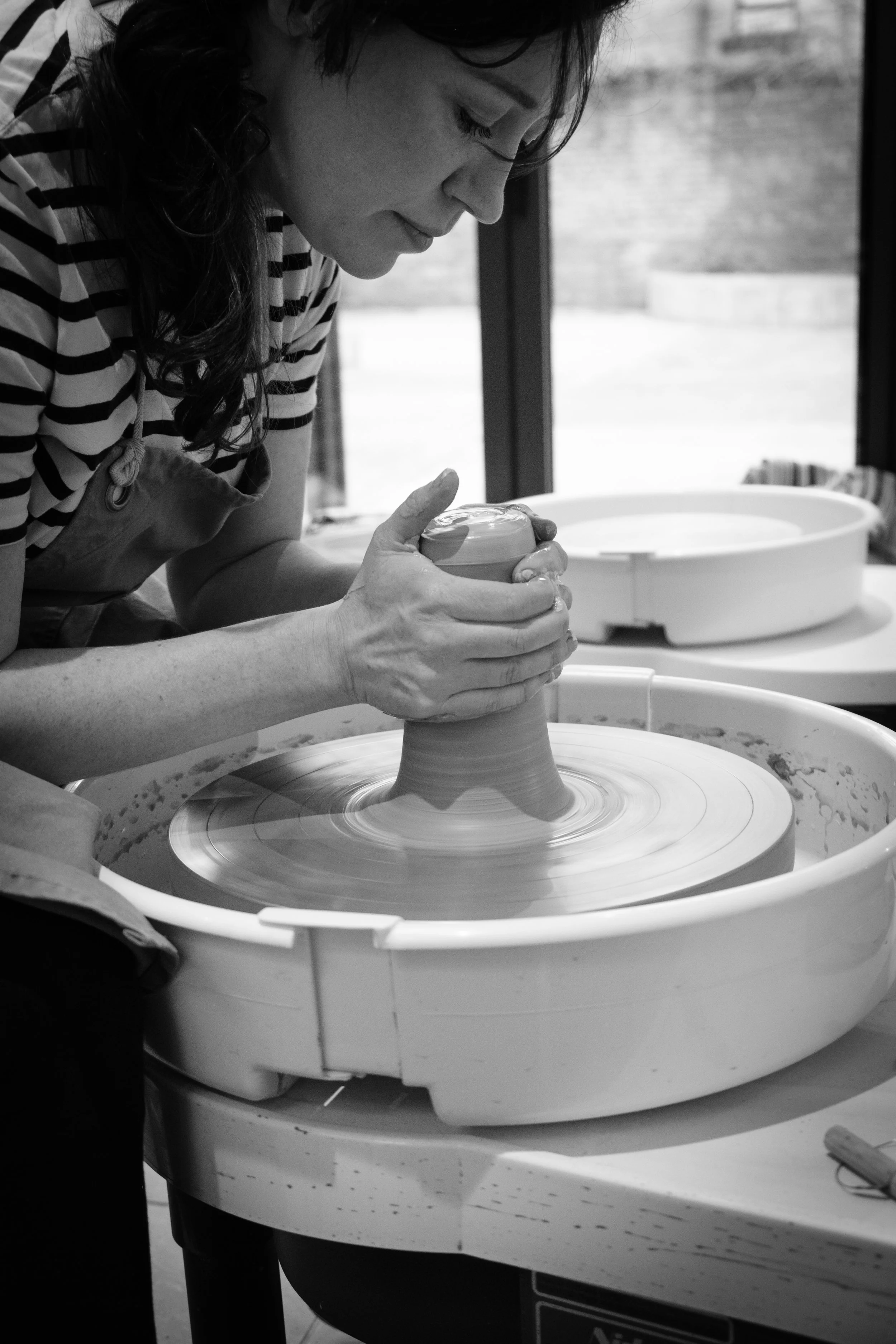
I don't see those variations as imperfections. They're part of the making process.
Clay also has a habit of reminding you that you're not entirely in charge. Glazes move, surfaces react and the heat of the kiln can produce subtle changes that are difficult to predict completely. Opening a kiln is still one of my favourite parts of making pottery for precisely that reason.
There's consistency, but not uniformity.
How something feels matters
We tend to think first about how an object looks, but with functional pottery, how it feels is just as important.
A mug might be beautiful but you'll soon stop reaching for it if the handle is uncomfortable or it feels awkward to drink from. The weight, balance, thickness of the rim and shape of the handle all matter.
Texture is particularly important in my own work. I'm drawn to contrasts between smooth and rough surfaces, matte and gloss glazes, carved marks and areas of exposed clay. I want a piece to be interesting to hold as well as to look at.
That's one of the pleasures of buying handmade pottery in person. Pick things up. Turn them over. Feel their weight. Put your fingers through the handle of a mug.
You'll usually know when you've found the one you want.
You know where it came from
There is something different about knowing where an object was made and something about the person who made it.
Each piece I make passes through my hands many times before it leaves the studio, from preparing and throwing the clay through trimming, decorating, glazing, firing and finally packing it up to go to its new home.
The landscapes I love inevitably finds its way into that process too. The dark mountain rock, pale birch bark, seagrass, lichen and changing colours of the Scottish seasons have all influenced different collections over the years.
That doesn't necessarily make a mug function any better.
But I think knowing the story of an object can change our relationship with it.
Perhaps you bought it directly from the maker. Perhaps you found it in a small independent shop while travelling. Perhaps it reminds you of a particular place, person or time in your life.
Objects have a way of gathering associations.
Handmade pottery is made for everyday life
I sometimes think the word "handmade" can make things sound more precious than they need to be.
Most of the ceramics I make are functional because I want them to be used.
I like the idea of beautiful objects being part of very ordinary moments. The first coffee of the morning. A bowl of soup. Flowers cut from the garden. Friends around a table.
Over time, those objects become part of the background of our lives.
I have favourite mugs at home and I'm sure most people do. There's something quietly soothing about reaching for the same one every morning. You know exactly how it feels in your hand and how much coffee it holds. You don't really think about why you choose it anymore. You just do.
For me, that's when a functional object has really earned its place.
Buying fewer things, more deliberately
I don't think handmade pottery needs sweeping claims about being better for the planet.
Ceramics require raw materials and considerable heat to fire and making them uses energy. That's part of the reality of the process.
What I do believe in is buying things more deliberately.
I'd rather own fewer objects that I genuinely enjoy using than cupboards full of things I feel indifferent about. Choosing something because you love its form, know where it came from and intend to live with it for years encourages a different relationship with what we buy.
Handmade pottery is durable but it isn't indestructible. Mugs get chipped. Bowls occasionally meet tiled floors. That's life.
The hope is simply that while they're with us, they're properly used.
So, why buy handmade pottery?
For me, the appeal isn't simply that something has been made by hand.
It's the thought behind the form, the evidence of the making process, the tactile qualities of clay and glaze and the small variations that make one piece different from another.
Most of all, it's the possibility that an ordinary object can gradually become something more personal through use.
That's ultimately why I make functional pottery.
Not to create things that sit untouched on a shelf but objects that find their way into people's homes and routines. Things that get filled with coffee, flowers, porridge or whatever else everyday life throws at them.
And perhaps, eventually, become the one you always reach for first.
If you'd like to see what I'm currently making, you can explore my ceramic collections or find my work through one of my stockists.